Key Points:
- Coaching Exchange Program: AS Monaco Academy hosted its third annual partner-club seminar at the Jean-Favre stadium in La Turbie on 28 and 29 October 2026, handing control of three U16 training sessions to guest educators.
- Partner Entities Participating: Visiting coaches represented three key partner clubs: AS Saint-Priest, AS Aix-en-Provence, and FC Versailles.
- Practical Pitch Execution: Guest coaches developed session frameworks in conjunction with AS Monaco staff, tailoring drills to the physical and technical development needs of the elite youth players.
- Drone Analysis and Debriefing: Each session was recorded via aerial drone footage, enabling immediate video debriefs to evaluate coaching methodologies and player responsiveness.
- Bilateral Knowledge Sharing: The initiative allowed professional academy staff to observe amateur resourcefulness while exposing elite U16 players to diverse tactical instructions.
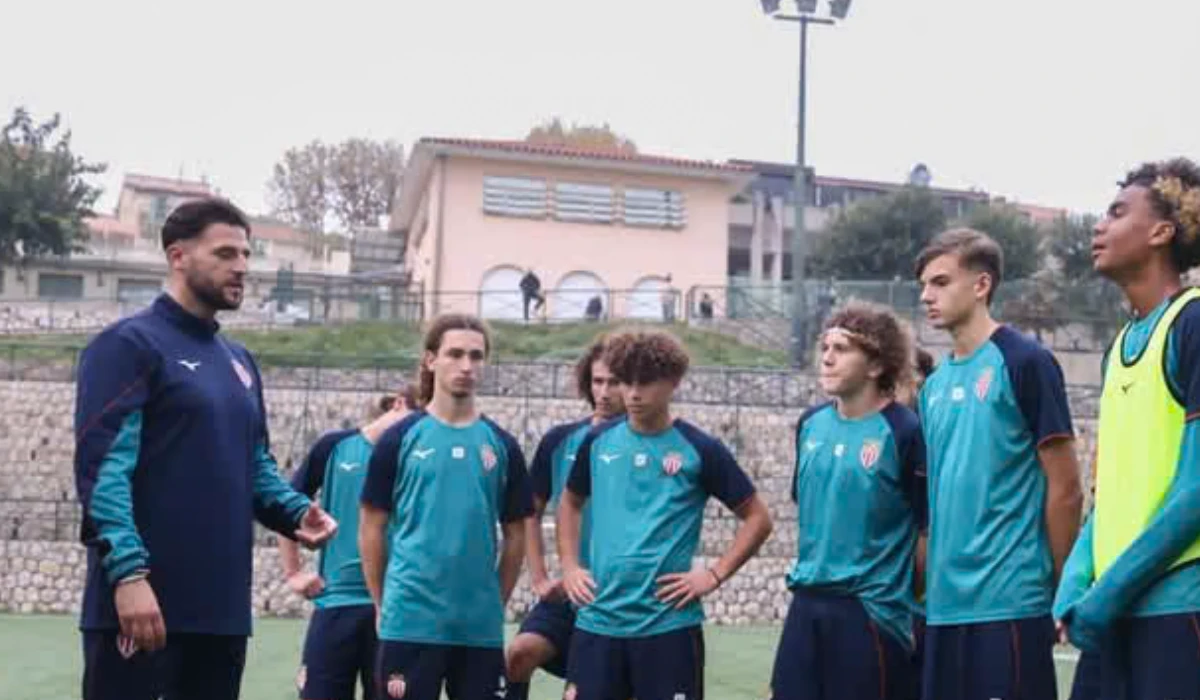
Monaco (Monaco Weekly Newspaper) October 31, 2026 – AS Monaco’s Youth Academy temporarily altered its internal coaching hierarchy at the Jean-Favre stadium in La Turbie by handing full control of three U16 squad training sessions to guest educators from partner clubs. Held on Wednesday, 28 October, and Thursday, 29 October 2026, the exercise formed the practical core of AS Monaco’s third annual partner-club seminar. Educators from AS Saint-Priest, AS Aix-en-Provence, and FC Versailles led tactical and physical drills designed in coordination with Monaco’s technical directors. The bilateral exchange aimed to benchmark professional academy standards against innovative amateur coaching solutions while testing the adaptability of Monaco’s elite youth prospects.
- Key Points:
- How did partner-club coaches structure the U16 training sessions at La Turbie?
- What benefits do amateur partner clubs gain from the AS Monaco seminar?
- How did AS Monaco’s U16 players adapt to unfamiliar coaching styles?
- Why does AS Monaco value coaching insights from amateur partner teams?
- Background of AS Monaco’s Partner-Club Network and Youth Academy Strategy
- Youth Development Systems and Partner-Club Collaborations
How did partner-club coaches structure the U16 training sessions at La Turbie?
As reported by official media officers at AS Monaco, visiting educators stepped directly onto the pitch to convert theoretical frameworks into high-intensity drills. AS Monaco Deputy Academy Director Mathieu Lacan noted that the organization prioritizes practical implementation, stating that “We’re fortunate to have a seminar that is very much focused on what happens on the pitch”.
The guest coaches worked in pairs to lead sessions while observing colleagues from other visiting clubs. As reported by Monaco’s press team, Steven Kamashi, U15 head coach at FC Versailles, highlighted the practical appeal of the initiative, stating: “We’re football coaches. That’s what we enjoy most”.
To prepare for the sessions, the visiting coaches collaborated with AS Monaco’s permanent staff to establish structural parameters while accounting for individual player loads. As reported by AS Monaco communications, Steven Kamashi explained that the coaching staff had to take into account “the specific needs of certain players, as well as where they were in their athletic development”.
Following the completion of each session, the coaches gathered for detailed video debriefs. The club utilized high-definition aerial drone footage captured during the drills to analyze positioning, movement patterns, and the clarity of instructions delivered by the visiting staff.
What benefits do amateur partner clubs gain from the AS Monaco seminar?
As reported by sports writers covering French youth football, the annual seminar serves as a formal knowledge-sharing pipeline between professional academies and grassroots organizations. Visiting coaches gain direct access to elite infrastructure, video analysis tools, and sports science data utilized at the La Turbie performance center.
As reported by AS Monaco media, Sidahmed Bouaza, a youth coach representing AS Aix-en-Provence, emphasized the educational value of observing elite environments. Sidahmed Bouaza stated that “When we have the chance to see different ways of working, we take that knowledge back with us and, most importantly, pass it on to our players”.
The collaborative setup allows partner-club coaches to observe how top-tier academies structure session tempos, manage positional tactical duties, and conduct video feedback sessions, which can subsequently be adapted for regional teams operating with smaller operational budgets.
How did AS Monaco’s U16 players adapt to unfamiliar coaching styles?
As reported by AS Monaco club journalists, the two-day seminar deliberately tested the adaptability of the U16 squad by introducing unfamiliar voices and tactical concepts. On Wednesday afternoon, the training shifted focus toward specific attacking and defensive situational drills, requiring players to execute unfamiliar patterns.
Monaco’s young players recognized the importance of remaining receptive to varied coaching philosophies. As reported by AS Monaco, U16 player Maxime-Olivier Heuyottobit stated: “We’re discovering different ways of seeing football, and it shows us that everyone has their own approach. As future footballers, we have to be able to adapt”.
Echoing those sentiments, teammate Lénys Mateus Francisco underlined the squad’s focus on maintaining professional discipline regardless of who leads the session. As reported by AS Monaco, Lénys Mateus Francisco stated: “You have to listen and apply what the coaches ask of us. We shouldn’t treat them differently from our own staff”.
During the competitive element of Wednesday’s session, players were divided into balanced teams for tactical small-sided games. Although the blue team ultimately won the final match of the session, guest coaches commended the entire squad’s application. As reported by AS Monaco press officers, Steven Kamashi remarked: “Everything went very well. The players were receptive right from the start. When you coach players from the AS Monaco Academy, you’re obviously working with quality players, so it was quite easy to put into practice what we had planned”.
Why does AS Monaco value coaching insights from amateur partner teams?
As reported by staff writers at Monaco’s technical department, the learning process during the annual seminar operates as a genuine two-way exchange. While elite academies boast extensive resources, amateur coaches frequently develop creative problem-solving methods due to operational constraints.
AS Monaco Deputy Academy Director Mathieu Lacan highlighted the structural differences between professional setup sizes and regional partner clubs. Lacan pointed out that a professional academy coaching team at Monaco can include up to six full-time staff members for a single age group, whereas an amateur coach often manages sessions entirely alone.
As reported by AS Monaco communications, Mathieu Lacan stated: “We try to meet their needs, but we can also draw inspiration from what is being done in amateur clubs. When you have fewer resources, you often come up with lots of ideas and find innovative ways of working. It also gives us an opportunity to question our own routines”. Lacan concluded that the overarching objective of the collaborative seminar is simply to “improve together” across all levels of the partnership network.
Background of AS Monaco’s Partner-Club Network and Youth Academy Strategy
AS Monaco’s youth academy, historically based at La Turbie, stands as one of European football’s most prestigious talent pipelines, having produced World Cup winners including Kylian Mbappé, Thierry Henry, and David Trezeguet. Over the last decade, the Princely club has modernized its recruitment and development strategies by formalizing strategic partnerships with select regional and national clubs, such as AS Saint-Priest, AS Aix-en-Provence, and FC Versailles.
These partnerships extend beyond traditional scouting agreements. The annual seminar, now in its third edition, was established to foster shared technical standards across all affiliated institutions. By offering partner-club educators access to Monaco’s elite training grounds, sports science methodologies, and drone-assisted video technology, Monaco strengthens its ties with key talent hubs across France. In return, the academy gains early visibility over top regional prospects who are nurtured by coaches aligned with Monaco’s overall tactical philosophy.
Youth Development Systems and Partner-Club Collaborations
The ongoing success of AS Monaco’s collaborative coaching seminar is predicted to encourage similar multi-tier partnership models across professional European football.
For the young players within the AS Monaco Academy, regular exposure to guest coaches will accelerate their tactical maturity and adaptability—key traits required when transitioning to senior professional football under different managers. Players who master quick adaptation to varying leadership styles are statistically more resilient when moving between youth setups, loan assignments, and first-team environments.
For partner clubs like AS Saint-Priest, AS Aix-en-Provence, and FC Versailles, the integration of advanced elite practices—such as drone analysis and tailored physical load management—will elevate the quality of grassroots coaching in their local communities. As these regional coaches return to their respective clubs, the trickle-down effect is expected to enhance overall player development standards at the amateur level, creating a more refined talent pool for French football as a whole.