
Key Points
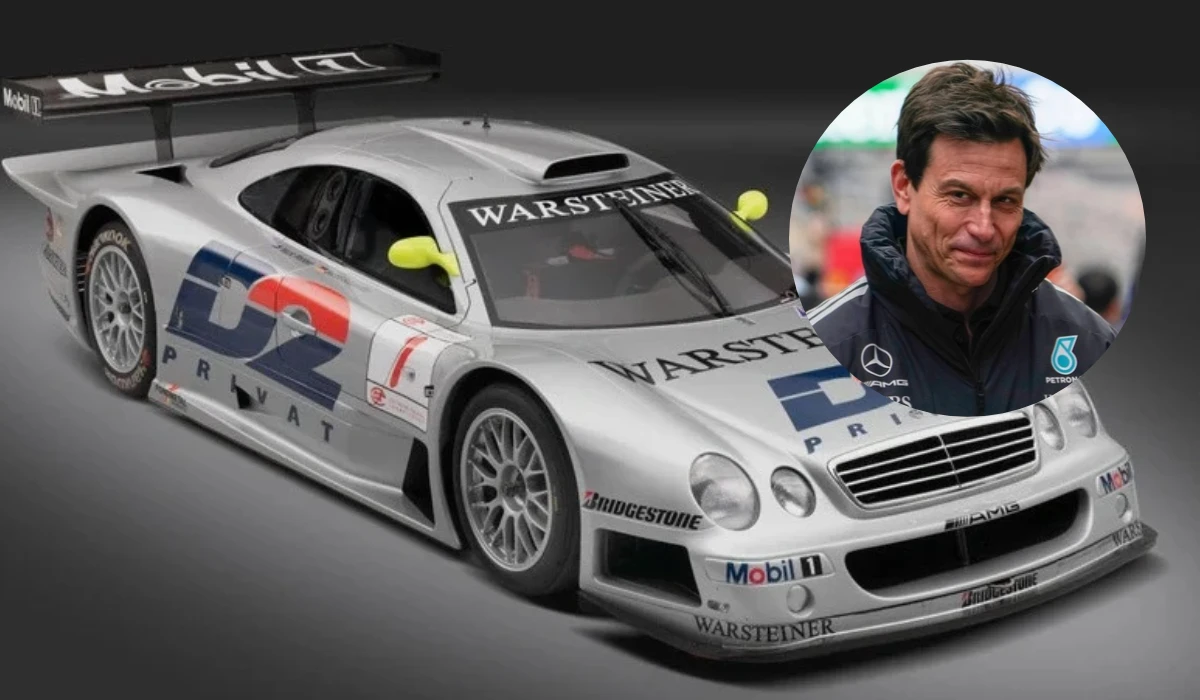
- Monaco Sightpoint: Mercedes-AMG Petronas F1 Team Principal and one-third team co-owner Toto Wolff was spotted driving an ultra-rare, road-legal Mercedes CLK GTR through the streets of Monte Carlo, Monaco.
- Extreme Valuation: Valued at approximately £8 million ($10 million USD), the vehicle represents one of the most exclusive and historically significant road-going supercars ever manufactured by the German automotive giant.
- Exceedingly Limited Production: Built purely as a homologation special for the FIA GT Championship in the late 1990s, only 28 road-legal “Straßenversion” units were ever constructed—comprising two prototypes, 20 coupes, and six roadsters.
- Monstrous V12 Performance: Powered by a 6.9-litre naturally aspirated AMG V12 engine producing 604 horsepower and 572 lb-ft of torque, the vehicle accelerates from 0 to 100 km/h (0 to 62 mph) in 3.8 seconds with a top speed approaching 320 km/h (200 mph).
- Fit Challenges for Wolff: Standing 6’5″ tall (195 cm), the 54-year-old billionaire team principal faces physical challenges fitting into the cockpit, which features a roof height under four feet (1.2 metres) from the ground.
- Motorsport Legacy: The GT1 race-spec precursor and its successor, the CLK LM, dominated the FIA GT Championship so completely in 1997 and 1998 that competing manufacturers withdrew, resulting in the cancellation of the GT1 class for 1999.
Monaco (Monaco Weekly News) October 17, 2026 – Executive Summary: Billionaire Mercedes-AMG Petronas F1 Team Principal Toto Wolff was spotted navigating the streets of Monaco behind the wheel of an £8 million ($10 million USD) Mercedes CLK GTR. As one of only 28 road-legal “Straßenversion” models ever produced by the German manufacturer in the late 1990s, the 604-horsepower V12 supercar stands as one of the rarest automotive assets in the world. It remains unconfirmed whether the vehicle belongs to Wolff’s private collection or represents a loan, given the 54-year-old executive’s notable 6’5″ stature relative to the car’s tight, low-slung race cockpit.
- Key Points
- What Makes the Mercedes CLK GTR One of the World’s Rarest Supercars?
- What Are the Performance Specifications and Physical Dimensions of the CLK GTR?
- How Did the CLK GTR Reshape Global Motorsport History?
- Background of the Mercedes CLK GTR’s Soaring Auction Value and Regulatory Status
- How This Sightpoint May Affect Luxury Automotive Markets and F1 Brand Image
What Makes the Mercedes CLK GTR One of the World’s Rarest Supercars?
The vehicle driven by the 54-year-old Austrian executive is far from a standard production sports car; it is a homologation special built out of competitive necessity.
As reported by Chris Deeley, Editor of Crash.net, the Mercedes CLK GTR came into existence because governing rules for the FIA GT Championship during the late 1990s required competing manufacturers to produce a minimum public production run of road-legal vehicles. Mercedes-Benz and its performance arm, AMG, developed the “Straßenversion” (literally “Street Version”) exclusively to meet these homologation mandates rather than for mass commercial sale.
According to Crash.net, Mercedes produced a total of only 28 road-legal units of the CLK GTR:
- Prototypes: 2 original factory testing units.
- Coupes: 20 production hardtop models.
- Roadsters: 6 open-top convertible variants.
When the vehicle originally hit the retail market in the late 1990s, it carried a list price of $1,547,620 USD, earning it an official entry in the Guinness World Records as the most expensive production car in existence at the time. It held that world record for nearly two decades until it was surpassed by track-focused hypercars like the Ferrari FXX-K in 2015.
What Are the Performance Specifications and Physical Dimensions of the CLK GTR?
Under the rear bodywork of the CLK GTR sits a pure racing engine adapted for street registration. The vehicle is powered by a massive 6.9-litre naturally aspirated AMG V12 engine mated to a six-speed sequential manual transmission.
As reported by Chris Deeley of Crash.net, the engine generates an astounding 604 horsepower and 572 pound-feet of torque. When pushed to its limits, the road-going race car achieves 0 to 100 km/h (0 to 62 mph) acceleration in 3.8 seconds, reaching a maximum top speed pushing 320 km/h (200 mph).
However, the car’s extreme, race-bred architecture makes it notoriously difficult to enter for taller drivers. Standing 6’5″ tall, Toto Wolff faces substantial physical hurdles inside the cockpit, where the roofline measures under four feet (1.2 metres) off the tarmac.
As reported by Chris Deeley of Crash.net, video footage captured during a 2025 event at the Dubai Autodrome documented Wolff attempting three or four different angles of entry to fold his frame into a CLK GTR owned by FIA President Mohammed Ben Sulayem. With physical assistance, Wolff eventually entered the vehicle and drove the 6.9-litre V12 machine around the UAE circuit. It remains unconfirmed whether the unit driven through Monaco belongs directly to Wolff’s personal collection or was borrowed from an associate.
How Did the CLK GTR Reshape Global Motorsport History?
The extreme nature of the road-going CLK GTR stems from the absolute dominance of its racing sibling on the track. The GT1 race-spec version, alongside its updated successor—the V8-powered CLK LM—effectively dismantled the competitive framework of top-tier sports car racing in the late 1990s.
During the 1997 FIA GT Championship season, Mercedes-AMG won six out of 11 races. In 1998, the German marque achieved an unprecedented clean sweep, winning every single race on the calendar.
As reported by Chris Deeley of Crash.net, the mechanical dominance of the CLK GTR and CLK LM was so absolute that rival manufacturers abandoned the GT1 category entirely. By the 1999 season, no other team or brand entered the GT1 class of the FIA GT Championship, forcing the FIA to cancel the GT1 class completely and run the championship using only GT2 vehicles.
Background of the Mercedes CLK GTR’s Soaring Auction Value and Regulatory Status
In the decades following its forced production run, the Mercedes CLK GTR has transitioned from an esoteric homologation special into one of the most coveted blue-chip automotive assets among international collectors. Due to its extreme rarity and motorsport heritage, auction valuations for surviving chassis have escalated into eight-figure sums.
At a high-profile 2023 RM Sotheby’s auction in Las Vegas, one of the six open-top Roadster variants sold for $10,235,000 USD (£8 million). The transaction occurred despite severe regulatory restrictions on driving the vehicle in key markets such as the United States. During initial manufacturing, Mercedes opted against certifying the CLK GTR to meet federal US motor vehicle safety standards. Consequently, imports into North America have historically been restricted under strict “Show or Display” regulatory exemptions, which limit annual road usage to no more than 2,500 miles (4,000 km) for vehicles of exceptional historical significance.
How This Sightpoint May Affect Luxury Automotive Markets and F1 Brand Image
Toto Wolff’s public appearance in the £8 million supercar carries multi-faceted implications for automotive collectors, brand marketing, and motorsport enthusiasts:
- For Ultra-Luxury Car Collectors and Auction Houses: High-profile public outings of iconic homologation specials by prominent F1 figures like Wolff will likely reinforce upward price trajectories for late-1990s GT1 assets. Auction houses will see increased demand for ultra-rare analog supercars as wealthy collectors seek historical investment vehicles with direct links to racing royalty.
- For Mercedes-Benz Corporate and F1 Brand Alignment: Seeing the team principal of Mercedes’ flagship Formula 1 outfit driving a legendary V12 icon on the streets of Monaco reinforces the brand’s heritage of engineering supremacy. It serves as an unscripted marketing moment that bridges Mercedes’ past motorsport dominance with its modern luxury and Formula 1 endeavors.
- For F1 Fans and Motorsport Historians: The sighting provides a rare, viral moment connecting modern sports leadership with iconic mechanical history, keeping interest alive in historical GT1 racing architectures among younger generations of motorsports supporters.