- Monaco has officially transferred the Presidency of the Committee of Ministers of the Council of Europe to Montenegro, concluding its inaugural six-month term in the position since joining the pan-European organisation in 2004.
- Monegasque Minister of Foreign Affairs and Cooperation, Isabelle Berro-Amadeï, formally handed over the symbolic key of the presidency to Montenegro’s Deputy Prime Minister and Minister of Foreign Affairs, Ervin Ibrahimović, during a formal session in Strasbourg on Tuesday, 10 November 2026.
- The transition marks Montenegro’s first presidency of the Committee of Ministers since it joined the Council of Europe in 2007; Montenegro will hold the rotating chair until 12 May 2027.
- Council of Europe Secretary General Alain Berset, alongside delegates from 46 member states—including France, the United Kingdom, Ukraine, and Andorra—formally commended Monaco for its diplomatic stewardship and commitment to human rights, democratic security, and the rule of law.
- The Monegasque and Montenegrin presidencies marked the transition by releasing a joint diplomatic declaration reaffirming unwavering support for Ukraine’s independence, sovereignty, and territorial integrity.
- Montenegro’s incoming presidency program focuses on three primary pillars: democracy in the digital age, equality and fundamental rights, and strengthening democratic security and the rule of law.
Monaco (Monaco Weekly Newspaper) November 11, 2026 – The Principality of Monaco has formally concluded its historic six-month tenure at the helm of the Council of Europe, transferring the Presidency of the Committee of Ministers to Montenegro during an official ceremony in Strasbourg on Tuesday, 10 November 2026. Monegasque Minister of Foreign Affairs and Cooperation Isabelle Berro-Amadeï presented the results of Monaco’s inaugural presidency before transferring the executive leadership to Montenegro’s Deputy Prime Minister and Minister of Foreign Affairs, Ervin Ibrahimović. The ceremony, attended by Council of Europe Secretary General Alain Berset and representatives of the 46 member states, celebrated Monaco’s contributions to multilateral dialogue, democratic security, and human rights. Montenegro now assumes the rotating presidency through 12 May 2027, prioritizing digital democracy, fundamental rights, and institutional resilience against geopolitical pressures.
- What Were the Primary Achievements of Monaco’s Presidency of the Committee of Ministers?
- What Are Montenegro’s Key Policy Priorities for Its 2026–2027 Term?
- How Does the Handover Impact the Council of Europe’s Strategic Roadmap?
- Background of the Particular Development After the News
- How This Development Can Affect European Member States, Microstates, and Western Balkan Integration
According to official diplomatic proceedings released by the Council of Europe Secretariat in Strasbourg, Monaco’s Minister of Foreign Affairs and Cooperation, Isabelle Berro-Amadeï, formally passed the symbolic key representing the Presidency of the Committee of Ministers to Montenegro’s Deputy Prime Minister and Foreign Minister, Ervin Ibrahimović, on Tuesday. The ceremonial transfer took place at the Palais de l’Europe in the presence of diplomatic delegations representing all 46 member states of the continent’s primary human rights organization.
As reported by official institutional channels of the Council of Europe, Minister Berro-Amadeï reviewed the achievements of the Monegasque presidency, which commenced on 15 May 2026. Reflecting on the Principality’s term, she described the occasion as a deeply emotional milestone occurring 22 years after Monaco originally acceded to the Council of Europe in 2004.
In her address to the Committee of Ministers, Minister Isabelle Berro-Amadeï highlighted the critical role of multilateral engagement, stating that every member state, regardless of its geographic size or population, possesses a meaningful contribution to make toward defending shared European values. She emphasized that Monaco’s active commitment to the core pillars of the Council of Europe would endure well beyond its formal presidential mandate, particularly in safeguarding human rights, strengthening democratic institutions, and upholding the international rule of law.
During the handover proceedings, Council of Europe Secretary General Alain Berset publicly recognized Monaco’s diplomatic performance throughout its six-month term. As reported by foreign correspondents present at the Palais de l’Europe, Secretary General Berset commended the Monegasque delegation for fostering constructive dialogue amidst complex geopolitical challenges. Delegations from numerous member states—including France, the United Kingdom, Ukraine, and Andorra—also delivered statements commending Monaco’s structured stewardship of the Committee of Ministers.
Expressing formal gratitude to her diplomatic team, Minister Berro-Amadeï praised Monaco’s Permanent Representative to the Council of Europe, Ambassador Gabriel Revel, alongside the specialized diplomatic personnel responsible for coordinating the presidency’s operational agenda. She further extended appreciation to the Council of Europe Secretariat, intergovernmental delegates, and the municipal authorities of the City of Strasbourg for their collaborative support throughout the term.
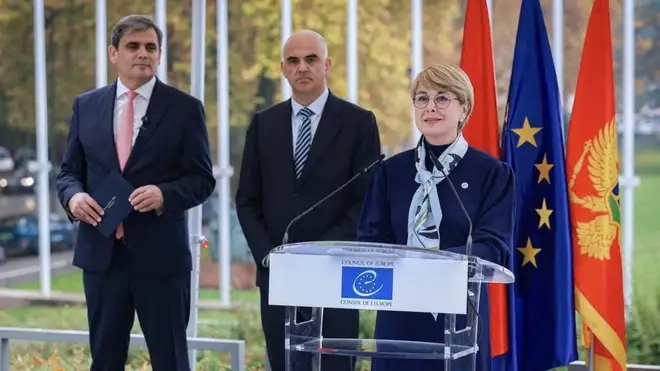
Following the formal session inside the Committee chamber, the transition ceremony moved outside to the main courtyard of the Palais de l’Europe. In the presence of Minister Berro-Amadeï, Minister Ibrahimović, and Secretary General Berset, the national flag of Montenegro was officially raised, signaling the formal start of Podgorica’s six-month term.
Upon assuming the chair, Montenegrin Foreign Minister Ervin Ibrahimović outlined Podgorica’s strategic roadmap, which will guide the Committee of Ministers through 12 May 2027. Highlighting the modern pressures facing European governance, Minister Ibrahimović stated: “We are taking on this responsibility at a critical moment for Europe. We are a small country. But we know that Europe’s strength has never depended solely on the size of its states. It has depended, and still depends, on the principles we defend, the choices we make and our willingness to act together.”
Addressing the broader institutional landscape, Minister Ibrahimović warned that democratic institutions across the continent are facing growing pressure from disinformation, social polarization, and declining public trust. As reported by regional media monitoring the Strasbourg proceedings, Ibrahimović stressed that “these challenges require political leadership, stronger institutions and collective action,” adding that the Council of Europe must remain fully equipped to shape responses to evolving geopolitical realities.
Reaffirming political solidarity during the institutional transition, the outgoing Monegasque presidency and incoming Montenegrin presidency published a joint declaration explicitly renewing their firm support for Ukraine’s independence, sovereignty, and territorial integrity within its internationally recognized borders.
What Were the Primary Achievements of Monaco’s Presidency of the Committee of Ministers?
Monaco’s tenure from May to November 2026 marked the Principality’s first opportunity to direct the policy agenda of the Council of Europe since its accession in 2004. Operating under the executive leadership of Minister Isabelle Berro-Amadeï and Permanent Representative Ambassador Gabriel Revel, Monaco’s presidency focused on pragmatic human rights mechanisms and multilateral cooperation:
- Promoting Universal Human Rights and Environmental Protection: Monaco leveraged its diplomatic platform to emphasize the intersection between environmental sustainability and human rights standards across member states.
- Fostering Inclusivity for Small Member States: The Monegasque mandate demonstrated that microstates can successfully lead complex intergovernmental negotiation processes, advocating for institutional equality across all 46 sovereign member nations.
- Strengthening the Rule of Law: Monaco oversaw continuous monitoring of the execution of judgments issued by the European Court of Human Rights (ECHR), reinforcing state compliance with international legal standards.
- Unified Geopolitical Stance: Concluding its term with a joint declaration alongside Montenegro, Monaco reinforced pan-European consensus regarding security in Eastern Europe and international law.
What Are Montenegro’s Key Policy Priorities for Its 2026–2027 Term?
Taking the chair for the first time since joining the Council of Europe in 2007, Montenegro has established a targeted agenda centered on contemporary institutional challenges. As outlined by Deputy Prime Minister and Foreign Minister Ervin Ibrahimović, Podgorica’s program focuses on three main thematic pillars:
- Democracy in the Digital Age: Countering online disinformation, regulating artificial intelligence applications in accordance with human rights standards, and restoring public trust in democratic systems.
- Equality and Fundamental Rights: Advancing anti-discrimination frameworks, protecting vulnerable populations, and promoting gender equality throughout member jurisdictions.
- Strengthening Democratic Security and the Rule of Law: Enhancing judicial independence, building anti-corruption capacities, and reinforcing the operational efficiency of national legal systems.
How Does the Handover Impact the Council of Europe’s Strategic Roadmap?
The seamless transition from Monaco to Montenegro underlines the continuity of governance within the Committee of Ministers—the principal decision-making organ of the Council of Europe. Composed of the foreign ministers of all 46 member states, the Committee oversees the implementation of pan-European conventions and monitors compliance with rulings from the European Court of Human Rights.
The handover ensures that ongoing initiatives—including the operationalization of damage registries and legal frameworks supporting Ukraine’s democratic security—remain fully funded and politically prioritized. By aligning successive six-month presidencies through joint statements and shared priorities, the Council maintains institutional momentum across changing geopolitical cycles.
Background of the Particular Development After the News
The Committee of Ministers operates as the executive decision-making body of the Council of Europe, bringing together foreign ministers or their Strasbourg-based permanent representatives. Presidencies rotate automatically every six months among the 46 member states in alphabetical order according to their English names.
Monaco’s presidency from 15 May to 10 November 2026 held significant historical symbolism for the Principality. Having joined the Council of Europe in October 2004 as its 46th member state, Monaco completed a 22-year journey to assume the rotating chair for the first time. Throughout its term, the Principality focused on demonstrating how small nations can contribute constructively to international law, judicial standards, and diplomatic mediation.
Similarly, Montenegro’s assumption of the chair on 10 November represents a major milestone in its post-independence diplomatic history. Having joined the Council of Europe in May 2007, Montenegro’s 2026–2027 presidency offers the Balkan nation a high-profile European platform to demonstrate its institutional alignment with Western democratic standards and advance its broader European integration objectives.
How This Development Can Affect European Member States, Microstates, and Western Balkan Integration
The successful completion of Monaco’s presidency and the launch of Montenegro’s term will produce several distinct geopolitical and institutional effects across Europe:
1. Diplomatic Standing of European Microstates
Monaco’s successful administration of the Committee of Ministers establishes a positive precedent for other European microstates, such as Andorra, Liechtenstein, and San Marino. By demonstrating that small diplomatic delegations can effectively manage complex intergovernmental agendas, Monaco has reinforced the principle of sovereign equality within pan-European institutions. This success is expected to encourage microstates to seek broader leadership roles in multilateral forums.
2. Western Balkan Regional Stability and EU Accession
For Montenegro and the broader Western Balkans region, holding the Council of Europe presidency provides an essential platform to demonstrate administrative capacity, judicial reform progress, and commitment to the rule of law. Podgorica’s focus on digital security, judicial independence, and anti-corruption will enhance its credibility among European Union member states, potentially accelerating its technical negotiations for EU membership.
3. Institutional Focus on Disinformation and Digital Security
Under Montenegro’s leadership, the Council of Europe is anticipated to step up its legislative and policy frameworks targeting artificial intelligence, hybrid threats, and digital disinformation campaigns. Member states can expect increased intergovernmental coordination aimed at protecting electoral integrity and defending democratic institutions against external political interference through 2027.